Showing posts with label heritage. Show all posts

Saturday, May 16, 2015

PORK ADOBO


I grew up enjoying this version of Adobo. This Adobo is different from other versions. Not your usual adobo cooked with soy sauce or toyo, but instead, patis was used, hence a paler version of it. Aside from the fish sauce, the other secret to this version is how it is cooked. Usually, we just simmer it until the meat is tender. But the big difference here is that after simmering, we SANGKUTSA it! Sangkutsa as my Mom told me is the process of drying the sauce as you stir-fry slowly on low fire to extract the oil and using it to fry the meat with. All the flavours come out of this process and this adds colour and a fuller and bolder flavour to the dish as you are frying it as it turns golden brown. It is the ideal result we are trying to achieve with ‘sangkutsa’. But some do it the short cut way and forgo it and uses toyo instead to put colour and flavor. In some regions, they call it, ”Sinangkutsang Adobo” for obvious reasons and uses annatto seeds to further add colour.

Like other dishes, it tastes better and better every time it is reheated. The sauce seeps into the meat so it is more flavorful! Sinangag cooked on the same pan it was reheated enhances eating experience. Drizzle your fried rice with the remaining adobo oil, pat it with patis and you’re good to go on a psychedelic adobo-sinangag trip! Be sure to have a good cup of coffee or tea afterwards. This is really a different version of the unofficial beloved national ulam! Good for breakfast, lunch, merienda (with kaning lamig) or dinner. But if on a diet, don’t serve this as you will not be able to control the urge for second, third or fourth servings of rice!

I remember my Tito Tony cooks this for pulutan. Although the dry version. He lets the sauce dry up and just fry it. Adobong Tuyo as it is called. When it comes to Adobo, he is an expert. Rheeza can attest to that as he sampled his version when we were living in Sta. Maria. My Mom taught me how to cook this. The first time I attempted this, I called her over the phone and told me step by step how it is done. She pointed out not to forget to SANGKUTSA. I had several attempts before having it done the way she cooks it.

I once read on an article written by Marie Pascual on the recipe of " Sinangkutsang Adobo, "While adobo is common and actually simple to prepare (no more than 5 ingredients), I boldly claim it's in the technique: not the chef kind but the family secret kind that's passed on from genertion to the next. Never written, just told in passing during stove top conversations." 

And with that, extra rice please!


Sawsawan:

Patis na may sili
Asin


Ingredients:
1 kg Pork Liempo (cut into large cubes)
½ kg Pork Kasim (cut into large cubes)
½ kg Pork Liver (cut into large cubes)
2 cups vinegar
1 cup patis
1 cup water
¼ cup cooking oil
3 bulbs garlic (crushed. You can include the skin for more added flavour)
1 tsp ground black pepper
1 tsp whole black pepper

Procedure:

1.       Combine all ingredients in a cooking pan.

2.       Simmer to boil. Do not stir until the vinegar is cooked. (“Kitchen legends” tells that it will taste bitter if stirred when the vinegar is not yet cooked. At least 3 minutes boiling. “Better safe than bitter!”)
3.       Stir occasionally.
4.       Put in low fire and simmer until the sauce thickens. Remove the thickened sauce and put in a container and save for later.


5.       Sangkutsa time. Cook until the oil of the meat appears.


6.       Fry using the oil from the meat. Add cooking oil; continue frying until the meat is golden brown.


7.       When the meat is golden brown, put the sauce back. This will deglaze the sauce, meat and garlic that were caramelized on the pan. All the flavours are concentrated on it and it will be mixed back to the sauce. This makes the Adobo “sinfully delicious”.
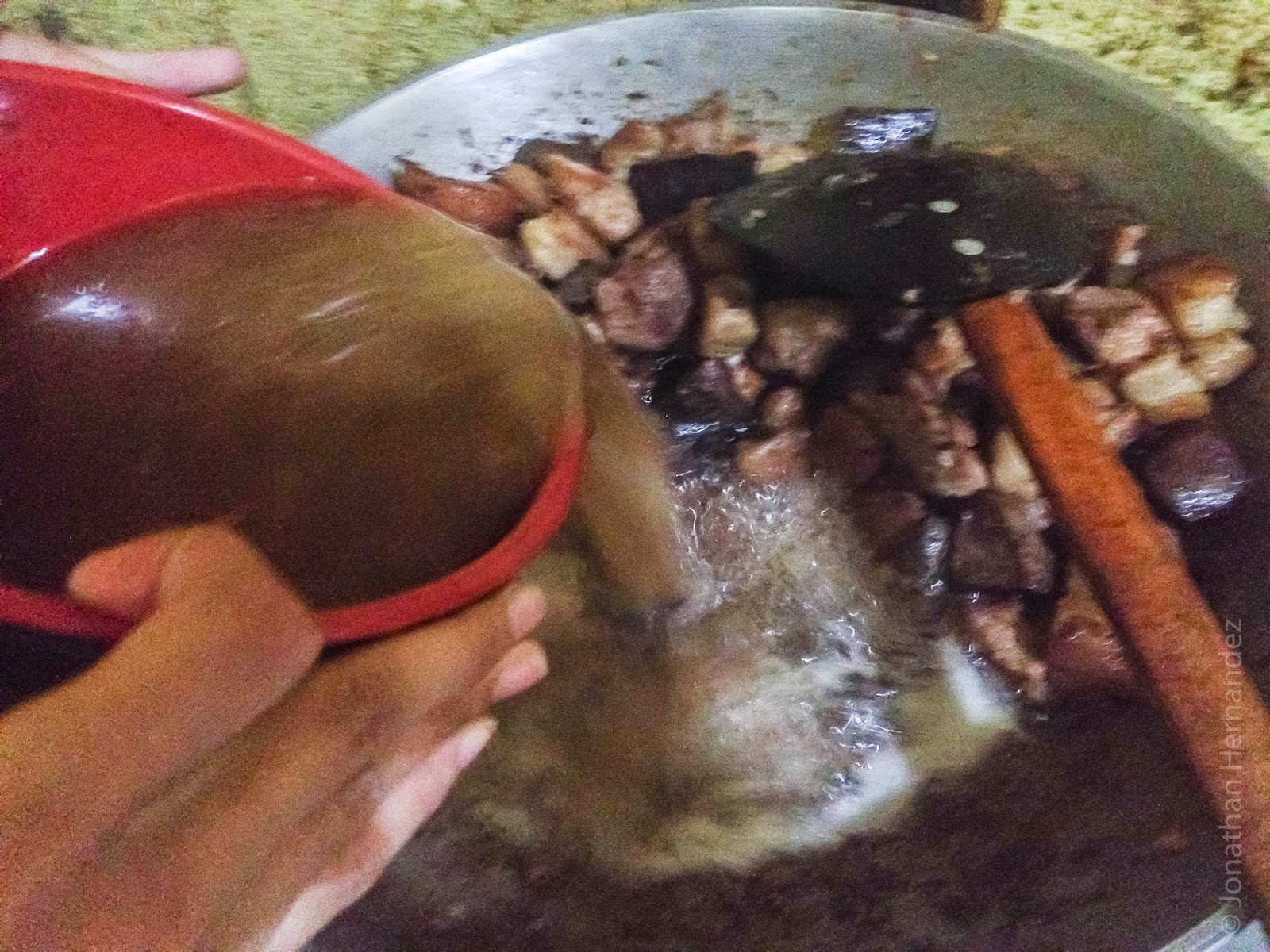

8.       Cook until the sauce thickens and become oily. When done, remove from heat and serve with hot steaming rice! (Although it is better with ‘bahaw’ or ‘kaning lamig”.)


9.       Fry some garlic as toppings. Include the skin.
10.    Enjoy!


Monday, February 9, 2015

SINIGANG NA ALIMANGO SA BAYABAS


When I was young, Sunday lunch was always special. We lived in my Grandmother’s house then and Sundays means all are present. My 3 Uncles have no work, my Mom and Dad and my sisters, we are all at home. My Tito Boy usually is the self-appointed cook every Sunday and I am the self-appointed Coke runner (Coca-Cola that is). I usually will grab a rattan basket and buy 2 bottles of Coke Litro at either Ka Linda’s Store or Ka Inggo’s.

A break from the usual “halabos” na alimango was the Sinigang na Alimango sa Bayabas. I always like slurping the sweet tangy soup of this dish and pouring it on a heaping serving of rice. Taking off the shell always creates anticipation as to how much “alige” there is. We always eat with our hands to easily take off the meat from the shell of the crab even if it’s difficult to scoop the rice due to the soup. Of course the meal would not be complete without “patis” to dip your fingers at before taking a handful of wet rice and putting it in your mouth and swallowing it. As always, you finish the meal with a glass of ice-cold Coke.

As I was in the market one Sunday morning, I saw a lady selling it and suddenly, I know what to cook for lunch. Here is my take on the dish with a little help from my Mom as I called her to recall how it is done.

Ingredients:

1 kilo Alimango (Mud Crabs)
½ kilo ripe guava
2 medium size onions
1 liter water for the soup
¼ cup patis
2 teaspoon rock salt
¼ cup sugar


Procedure:

1.       Boil water.
2.       Slice guava and put in water. Boil until cooked.
3.       Remove from water using a strainer. Mash on a bowl and strain the juice back on the soup.
4.       Add patis, rock salt and sugar. Reduce or add quantity according to taste. (It should be sweet-salty-fruity taste).
5.       Put in onions.
6.        Bring to a boil.
7.       Add the Alimango (if the crabs are too big, cut them in half if you like).
8.       Boil until it’s done. ( the crabs are done when they turned orange)
9.       Serve with rice and patis. Ice cold Coke is a must!
10.   Enjoy!


Tuesday, June 18, 2013

The Taal Batangas Heritage Tour


I have never been to Taal, Batangas before, but I was inkling to go there for the longest time. It being a Heritage town obtained my attention knowing that there is so much history to be learned from visiting. 

I was unable to join a tour organized months before. Eric my photography classmate invited me but my schedule did not permitted me. 


June 12, 2013, the same organizers conducted the tour, led by Sir Derrick Gerardo C. Manas, dubbed as "Taal Batangas Tour - Independence Day Special".


I was with my wife Rheeza and our friend Bing and Eric (second time around). We left Manila at around 6:30 am expecting to arrive in Taal at 9am. We took SLEX and exit at Sta. Rosa to take the Tagaytay route, which we found out was the long way instead taking another route. We got lost as usual so we arrived at Taal around 9:30 am.


We met in front of the Municipal Hall began with some introduction of our selves. Sir Derrick then led us to the Casa Real and told the history of it.
Casa Real - Taal Municipal Hall

Our next stop was the Marcela Agoncillo House. As we know, she was one of the makers of our flag. 


Marcela Agoncillo House
Marcela Agoncillo Shrine
 
Details inside the Agoncillo house

 Our next stop was Villa Tortuga. Villa Tortuga is an old house where you can have your pictures taken wearing period costumes. You can also dine upstairs wearing those costumes like the Spaniards and the Illustrados used to in those old days.


For only P250.00 you can have you pictures taken wearing costumes. My tour mates grabbed the opportunity and rummaged through the pile and gamely posed. For us photo enthusiast, this is a different photo shoot. This could have been a Cosplay 19th Century edition!!


Feel how people dress in those days


The groups take on the making of the Philippine flag.


On a less serious note...


The big shells will lead you upstairs and see the intricate interior of the house.


We enjoyed our stay here specially the photo shoot. It is not always that you have the chance to shoot with this kind of theme. if ever I'll be fortunate to come back, I'll see to it that I will wear those costumes and give my best Jose Rizal pose.


Our next stop is the Apacible house and the Galleria Taal where the Camera Museum is housed, but let us discuss that in the next blog, The Taal, Batangas Heritage Tour Part 2!


All photos Property of Jonathan P. Hernandez. Please do not reproduce or publish without the author's permission or knowledge. Copyright 2013